
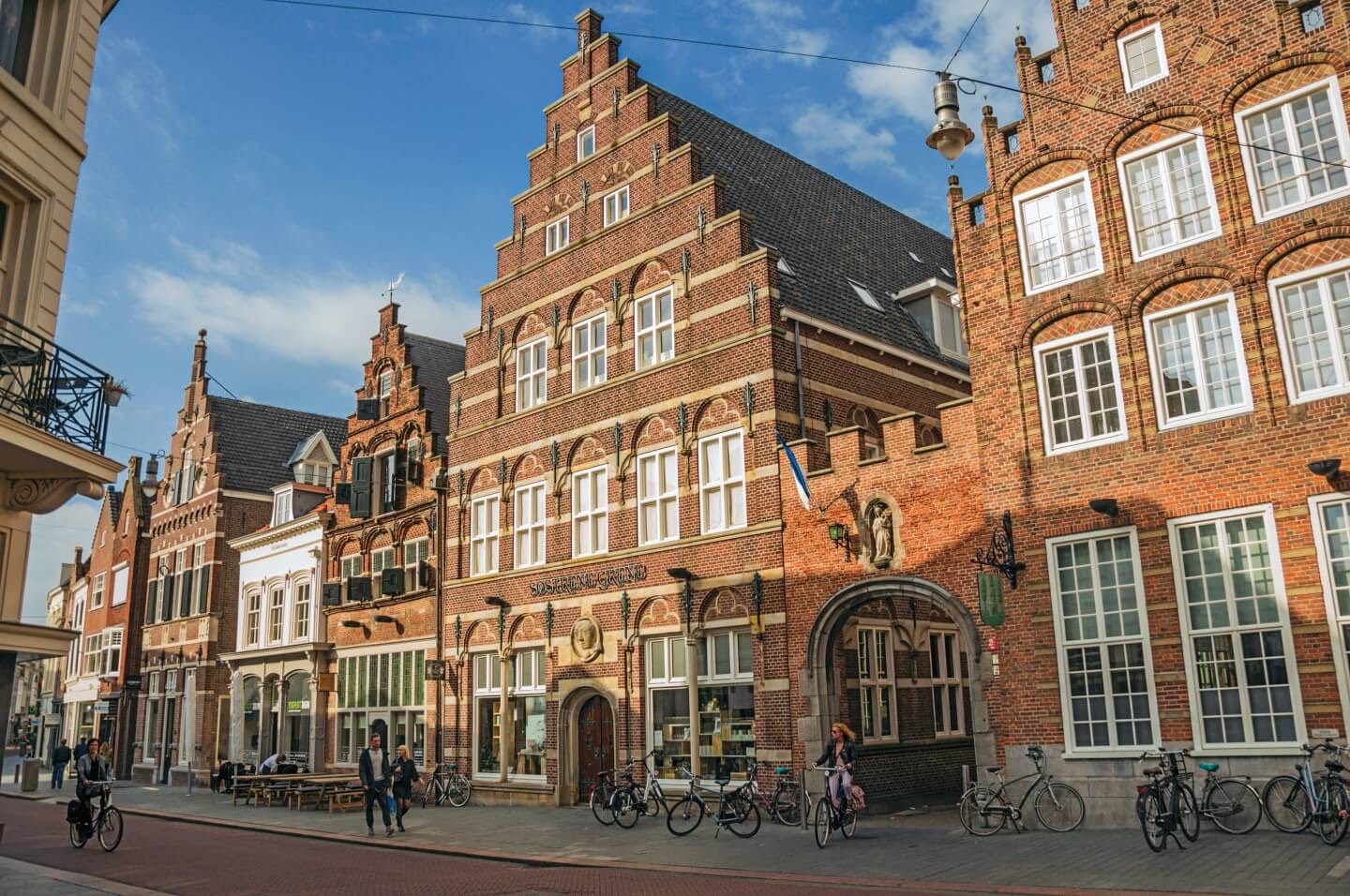
Painting a monument house in the Netherlands
Repainting a listed building in the Netherlands is allowed without a permit as long as you keep the existing colour and use a comparable paint type; changing the colour, the finish or the material of a protected element generally requires an omgevingsvergunning from the municipality. Rijksmonumenten (national monuments) and gemeentelijke monumenten (municipal monuments) follow similar principles, with the local heritage department (Monumentenzorg) as your first point of contact. The paint itself should be breathable and compatible with historic timber and lime-based substrates.
Liever Nederlands? Bekijk deze pagina in het Nederlands
What monument status means for painting
Rijksmonument versus gemeentelijk monument
The Netherlands protects historic buildings at two main levels. A rijksmonument is listed nationally by the Cultural Heritage Agency (Rijksdienst voor het Cultureel Erfgoed) because of its significance to the country as a whole; there are around 63,000 of them. A gemeentelijk monument is designated by the municipality for its local value. In addition, many towns have a beschermd stadsgezicht, a protected townscape, which places rules on the exterior of all buildings within the area even if the individual house is not listed.
You can check any address on the national register or via your municipality's website. The centres of 's-Hertogenbosch and Breda are both protected townscapes with hundreds of listed houses between them, and many of the canal-side and market-square properties expats rent or buy there fall under one or both regimes. Eindhoven and Tilburg have fewer listed houses but notable industrial and interwar monuments.
Monument status protects the exterior and, in the case of many rijksmonumenten, significant interior elements too. For painting, the relevant question is whether what you plan to do changes the appearance or the material of a protected part.
When you need a permit to paint
Like-for-like maintenance does not require a permit. Repainting timber frames, doors and shutters in the same colour with a paint of the same type, sanding and repairing the existing woodwork, and renewing putty or sealant all count as regular upkeep and are actively encouraged; a well-maintained monument is what the rules are designed to achieve.
A permit, formally an omgevingsvergunning for altering a monument, is generally needed when you want to change the colour, switch from an opaque paint to a stain or the other way round, paint previously unpainted brick or stone, or replace a painted timber element with a different material. Municipalities usually have a colour advisor or a heritage officer who will tell you quickly whether a proposed colour is acceptable, and many towns publish historic colour charts for their protected areas. Applying for a permit is done through the national omgevingsloket and typically takes eight weeks.
Painting without a permit when one is required can result in an order to restore the original colour at your own expense, so it is worth a short conversation with Monumentenzorg first. A painter who works regularly on monuments can usually tell you where the line is before you contact the municipality.
Choosing a paint system for historic timber
Historic frames are often made of dense, slow-grown softwood or oak that has survived a century or more precisely because it was allowed to breathe. Modern high-build acrylic coatings can trap moisture in old timber and accelerate decay. For monuments we generally recommend breathable, alkyd-based or hybrid systems from Sikkens or Sigma that have a long track record on heritage joinery, applied over a proper oil-based primer. Linseed-oil paints are an option on some very early buildings and where a heritage officer specifically asks for them.
Rendered and lime-plastered facades need mineral or silicate paints that let the wall release moisture; ordinary masonry paint on lime render is a common and expensive mistake. Ironwork such as railings and balconies should be treated with a rust-inhibiting primer and a traditional gloss.
Colour matching matters. The correct historic tone is usually determined by scraping back paint layers in a discreet spot, and municipal colour charts often specify exact references. We document the existing colour before starting so there is never a dispute about what was there.
Repairing wood rot on a listed building
Wood rot is as common on monuments as on any other Dutch house, and heritage rules strongly favour repair over replacement. Two-component epoxy consolidation and repair is widely accepted by heritage officers because it preserves the original timber, the original joints and the original profile while permanently stabilising the decayed section. Where a piece is beyond repair, the replacement should be in the same species and profile, ideally spliced in rather than removing the whole element.
Kivits Vastgoedonderhoud uses epoxy systems suitable for heritage work and photographs each repair before, during and after so the record can be shared with the municipality if required. Our wood rot repair page describes the method in detail, and our guide to wood rot in Dutch houses explains how to spot the early signs.
On a monument, replacing timber frames with uPVC is essentially never permitted on visible elevations, which is one more reason to keep the coating in good condition.
Practical steps and how we help
If you own or manage a listed house in Den Bosch, Breda or elsewhere in Noord-Brabant, start by confirming the status on the register, then decide whether you want to keep the current colour. Same colour, same paint type: book the work. New colour or finish: talk to the municipal heritage officer, and get your painter to prepare a short proposal with colour references for the application. Timing follows the same rules as any exterior job; see our guide on the best time of year for exterior painting.
Leroy Kivits and the team have worked on protected properties in the historic centre of 's-Hertogenbosch and around Breda. We provide a free inspection, a written quote within 48 hours, English-language communication and a 5-year warranty on paintwork and wood rot repair. Kivits Vastgoedonderhoud is registered under KVK 94153965.
Contact us to arrange an inspection, or read about our full exterior painting service.
Our services
Exterior painting
Window frames, doors, fascias and facades.
Wood rot repair
Epoxy repair instead of replacement.
Interior painting
Walls, ceilings and woodwork, dust-free.
Airless spray painting
Seamless walls and ceilings.
Wallpapering
Glass-fibre, renovation fleece and patterns.
HR++ window glazing
Insulating glass installation.
Frequently asked questions
Do I need a permit to repaint my monument in the same colour?
Generally no. Repainting in the existing colour with a comparable paint type counts as maintenance. A permit is usually required only when you change the colour, the finish or the material of a protected element. Confirm with your municipal heritage department if in doubt.
Can I paint my monument any colour I like if I get a permit?
The municipality will assess whether the colour fits the historic character of the building and the street. Many towns publish approved colour charts for their protected areas, and heritage officers will usually steer you towards a historically appropriate tone.
Are there subsidies for maintaining a monument?
The national government and some provinces and municipalities offer maintenance subsidies or low-interest loans for rijksmonumenten, and some municipalities support local monuments too. Conditions change regularly, so check the Cultural Heritage Agency and your municipality for current schemes.
Is epoxy wood rot repair allowed on a listed building?
In most cases yes. Heritage authorities generally prefer epoxy repair because it retains original timber and profiles. For significant elements it is sensible to inform the heritage officer beforehand and keep photographic records.
Does Kivits handle the permit application?
We can prepare the technical part: colour references, the proposed paint system and photographs of the existing condition. The application itself is submitted by the owner via the omgevingsloket, and we are happy to guide you through it in English.
Need a painter? We speak English.
Free on-site inspection. Written quote within 48 hours. 5-year warranty.
Call +31 6 36402640Or email usServices
- → Wood rot repair in Den Bosch & Noord-Brabant
- → Exterior house painting in Den Bosch & Noord-Brabant
- → Interior painting in Den Bosch & Noord-Brabant
- → Airless spray painting in Den Bosch & Noord-Brabant
- → Professional wallpapering in Den Bosch & Noord-Brabant
- → HR++ insulating glass installation in Den Bosch & Noord-Brabant
Areas
Guides for expats
- → Who pays for exterior painting in the Netherlands: tenant or landlord?
- → How often should you paint window frames in the Netherlands?
- → Wood rot in Dutch houses: why it happens and how to fix it
- → The best time of year for exterior painting in the Netherlands
- → VvE painting explained: how Dutch owners associations handle exterior work
- → Nederlandse versie
Ready for a painter who speaks your language?
Free inspection, clear written quote and a 5-year warranty. Serving all of Noord-Brabant.